The Air Our Team Breathes: Why Our Al Quoz Warehouse Runs MedicAir Pro Max Air Purifiers
Glass, bottles and boards reach us by truck, packed in cartons, and dust comes in with every load. Our team works in that air all day, so cleaning it is part of how we run the floor. What we use, why we chose it, and what it does not do.

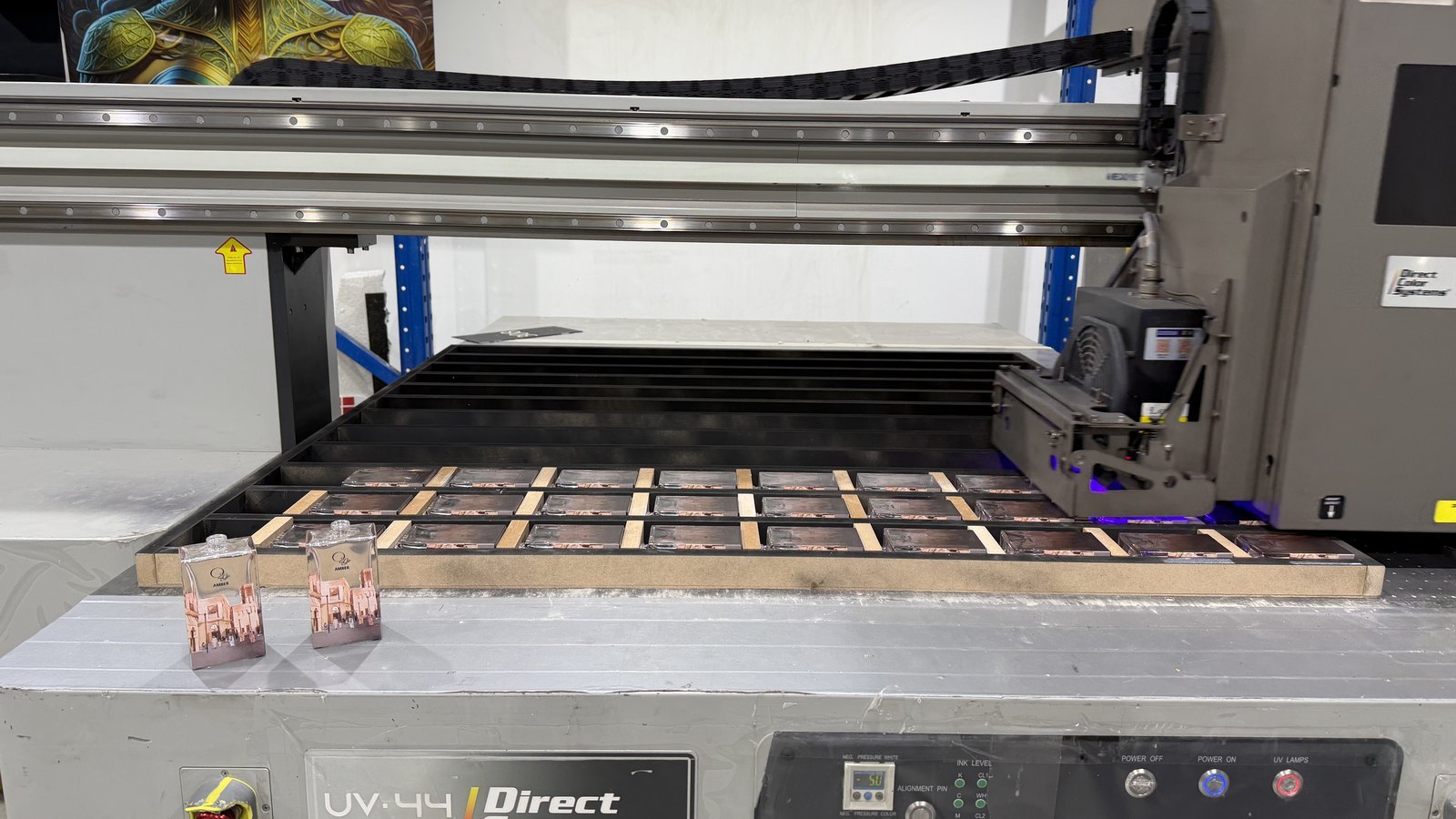
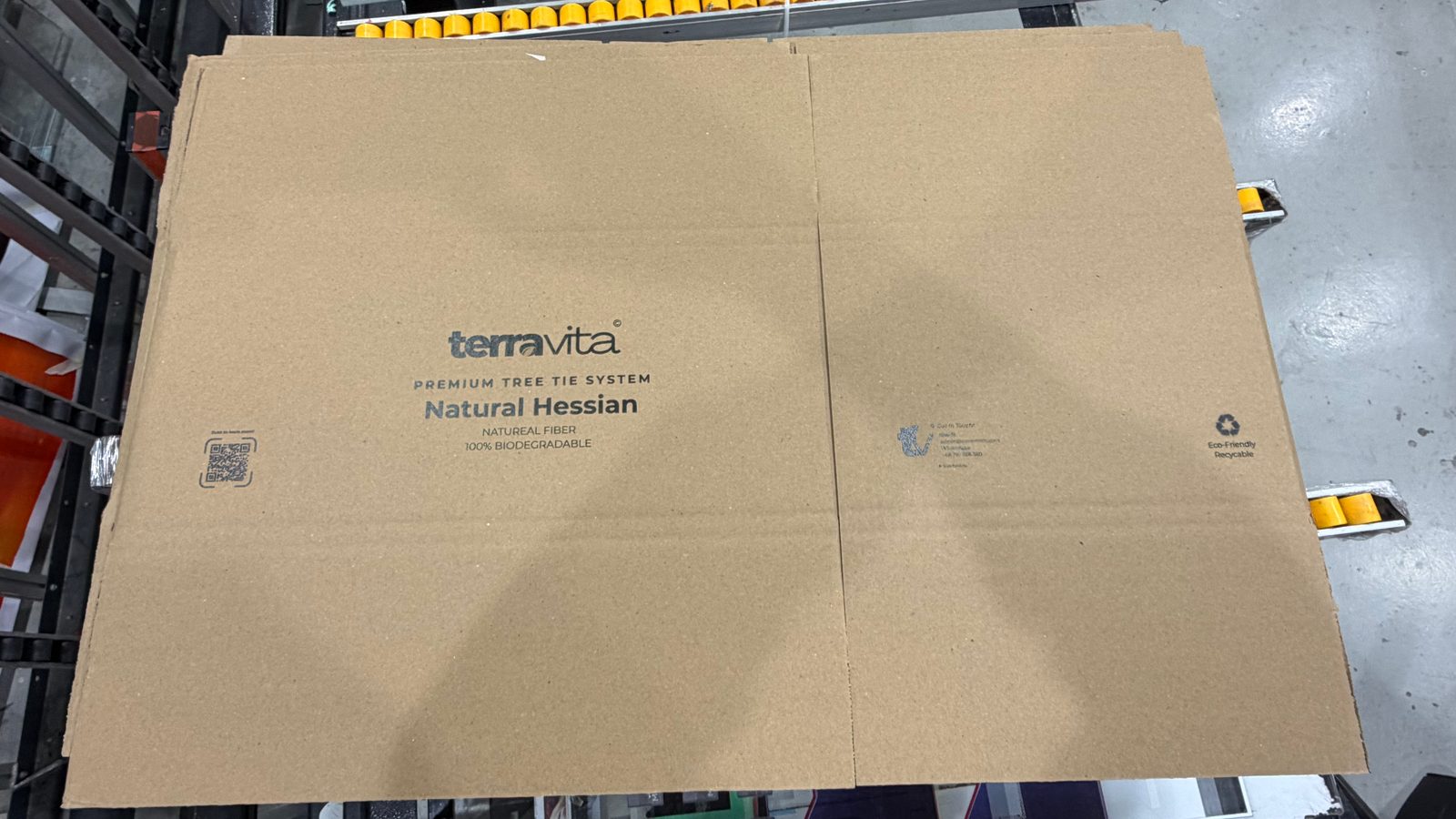
Most of what we print arrives at our door in a box. Clients send us their own glass and their own perfume bottles, and nearly everything else arrives the same way: on a truck, wrapped, packed and stacked in cartons, into our 3,000 m² warehouse in Al Quoz 1. Every load brings dust in with it, and the people who unpack it, clean it and print it spend their whole working day in that air.
We count that air as part of the workplace we owe our team, as much as the machines they run. Across the production floor it is now cleaned by MedicAir Pro Max air purifiers, supplied by HawaQ. One disclosure first: HawaQ is the air quality company in the same Dubai group as Sun Studio, so read our view of the machines with that in mind.
This is the people side of a subject we have written about before. Dust and moisture are also a print quality problem, and that part is covered in why our print floor runs a dehumidifier. This article is about the team. The airflow, filter, noise and sensor figures on this page are MedicAir’s published specification, not measurements we made.
Where the dust in a print warehouse comes from
Nobody makes dust on purpose. On our floor it comes from four places, and every one of them is part of a normal working day.
- The loading door. When a truck backs up and the roller door goes up, Al Quoz air comes straight in, with whatever the road, the neighbouring workshops and the wind are carrying that day.
- Cartons and packing. Corrugated board sheds fibres when it is cut, torn, folded and flattened, and fillers, foam and wrap add their own. Every box opened on the floor puts a little more into the air.
- The materials themselves. Glass travels with paper interleaving, bottles in dividers and sheets under film, and all of it collects dust in the truck and on the pallet before it reaches us.
- Movement. Dust that settles does not stay settled. Trolleys, pallets and people walking between the door, the tables and the presses lift it back up all day.
The heavier particles fall within minutes, onto the floor and onto the work. The finest stay in the air far longer, and that is the part a person breathes. You rarely see it in the air. You see it as a speck on a black panel under the lamp.

Why the air matters to the people on the floor
A print day is long. Setting up a job, cleaning and pre-treating the surface, printing, checking and packing all happen in the same open space, and our production team is on that floor from the first job to the last. The dustiest jobs, opening cartons and unwrapping glass, happen on the same floor as the printing.
Air conditioning makes a Dubai warehouse bearable, but it moves the same air around the room. The filters in most air-conditioning units are there to protect the machine, not to clean the air for the people in the room. Dust that comes in through the loading door stays in the room until something takes it out.
We are a print studio, not a clinic, and we make no health claims. What we can say is simple. Clean air is a basic part of a decent workplace, and in a building that takes deliveries all day it does not happen on its own. So we treat it the way we treat the presses: as equipment that has to be chosen, run and looked after.
Why we chose the MedicAir Pro Max
Size came first. A purifier made for a bedroom is lost in an open production hall, and a few small units in corners would leave most of the floor untouched. MedicAir rates the Pro Max at a clean air delivery rate (CADR) of 1,500 m³ of air an hour, the largest of the three MedicAir models HawaQ supplies, which is why it was the model for our floor.
Then what it filters. MedicAir describes four stages inside the unit:
| Stage | What it does | Why it matters on a print floor |
|---|---|---|
| Pre-filter | Catches the larger dust, fibres and hair | Carton fibres and floor dust are most of what a warehouse makes, and the pre-filter keeps them off the main filter |
| H14 HEPA filter | H14 is the class in the European standard EN 1822 for filters that capture at least 99.995% of particles at their most penetrating size | Fine dust is what stays in the air longest, and it is what people breathe |
| Activated carbon layer | Adsorbs odours and some gases | Helps with the smell of a busy floor. It is not extraction, as explained below |
| UV-C reaction chamber | Ultraviolet light inside the closed unit, part of MedicAir’s design | It works on the air passing through the machine and does not shine into the room |
Then mobility. The Pro Max stands on wheels, at 580 × 380 × 750 mm and 29 kg by MedicAir’s figures, and in a warehouse that matters more than it sounds. The dusty spot moves with the work: the loading door when a delivery comes in, the unpacking table after it, the press after that. A purifier that can be rolled to where the dust is being made is more use than one fixed in a corner.
And noise. MedicAir lists the Pro Max at 28 to 54 dB from its lowest to its highest setting. We have not metered it ourselves. On a floor where people talk across the presses all day, a machine that roars is a machine somebody switches off.

It measures the air as well as cleaning it
Each Pro Max carries a laser particle sensor and a CO₂ sensor, and MedicAir’s app keeps the readings over time. That turns the air on a warehouse floor from an opinion into something that can be looked at: whether the particle reading climbs when a delivery comes in, and how quickly it falls again.
The CO₂ reading answers a different question. People breathe out CO₂, so in a closed, air-conditioned space it rises through the day when not enough fresh air is coming in. A purifier cannot fix that, because filtering air does not add fresh air. What the sensor does is show when the answer is ventilation.

What an air purifier does not do on a UV print floor
We want to be exact about this, because it is where air purifiers get oversold.
- It does not replace ventilation and extraction for ink chemistry. The activated carbon helps with odours, but vapour from UV inks, primers, cleaners and adhesion promoters is governed by each product’s safety data sheet: the ventilation and extraction in the room, how the product is handled and the protective equipment the sheet calls for. A purifier works alongside those requirements, not instead of them.
- It does not add fresh air. CO₂ only comes down when outside air comes in.
- It does not dry the air. Humidity is a separate job on our floor, done by Stadler Form Lukas Pro dehumidifiers, which we wrote about in humidity and dust control before we print.
- It is not a medical device. MedicAir says its purifiers were developed by UK medical experts, but on a print floor they are workplace air cleaners, and that is how we describe them.
Clean air is part of looking after the people who print
Our production team handles work that cannot simply be swapped for another piece: a client’s own glass, a run of their own perfume bottles, a set of signs that have to match each other across a building. We ask for colour matched to a brand guide and finishes that pass inspection under a lamp, and they deliver it standing at the presses through a full working day. The least we owe them in return is air that is as clean as we can make it.
It is the same thinking that put quiet dehumidifiers on the floor: equipment is chosen for the people standing next to it, not only for its specification. We have printed in Al Quoz since 2011, and the people on the floor are a large part of why clients keep coming back.
If you run a warehouse or production floor in Dubai
The calculation we made applies to most warehouses in this city. A few practical points from our side of it:
- Find where the dust is made. Loading doors, unpacking, cutting, sanding and packing. Purifiers do the most good close to the source.
- Size by air volume, not floor area. Multiply the floor area by the ceiling height, then compare that volume with the clean air the purifiers deliver. A 500 m² zone with a 6 m ceiling holds 3,000 m³ of air; two purifiers at 1,500 m³ an hour each would put that whole volume through a filter about once an hour.
- Keep the doors closed between deliveries, and open cartons in one area rather than across the whole floor.
- Keep the inlets clear and change the filters on schedule. A purifier boxed in by pallets, or running on a clogged filter, cleans much less air.
- Measure before and after. A particle and CO₂ reading tells you whether the plan is working, and when the answer is fresh air rather than more filtration.
HawaQ, which supplied ours, sizes and supplies industrial air purification for warehouses and production floors in Dubai and across the GCC, and has written up our warehouse as a case study.
Common questions
Does a printing warehouse need an air purifier?
Where does dust in a warehouse come from?
What does H14 HEPA mean?
How many air purifiers does a warehouse need?
Does an air purifier remove UV ink fumes?
Does an air purifier lower CO₂ levels?
Have a job for our team?
Glass, bottles, signage or something harder: send us the brief, and we will tell you honestly what will work and print a sample on your own material. You are welcome to see the floor while you are here.
Sun Studio LLC
Al Quoz First, Dubai, United Arab Emirates
Call: +971 4 346 7422
Email: info@sunstudio.ae