Wall Printing in Dubai: What the wallPen Is, and What It Changes
The wallPen is a printer that travels to the wall and prints onto it. No sheet, no adhesive, no seam. What that changes for anyone specifying a wall.
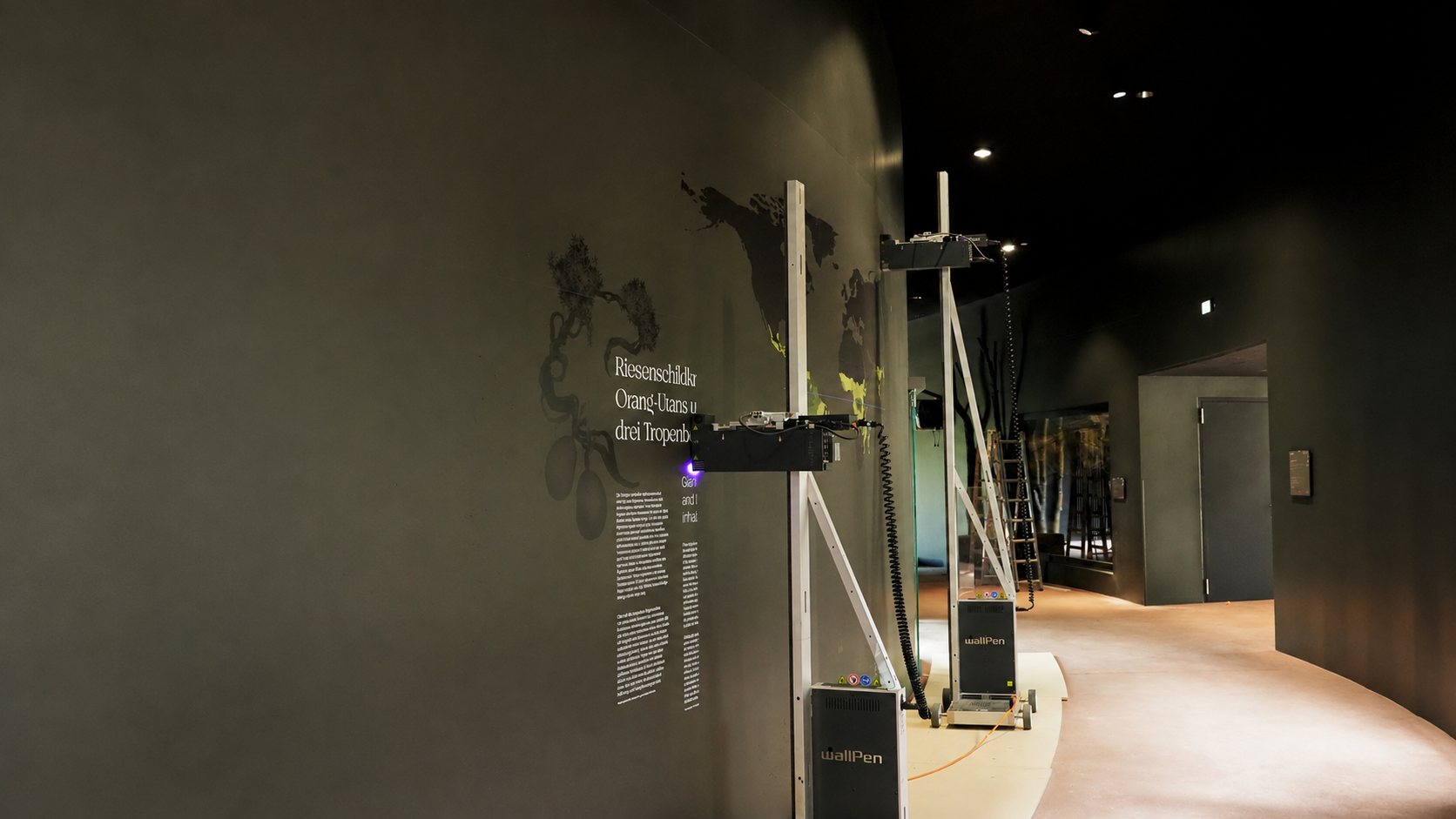
Nearly every way of putting an image on a wall makes the image somewhere else first. Wallpaper is printed on a roll. Vinyl is printed on film. A panel is printed, cut, then hung. All three end the same way: a sheet of something is carried into the room and fixed to the wall. The wallPen does not work like that. It is a printer that travels to the wall and prints onto the wall.
Sun Studio runs a wallPen E2 in Dubai. It is a wall printing machine built in Germany, brought to site and set to work against the wall itself, on any material and at any size. PRO TECHnology Middle East, our parent company, is the authorised distributor for the machine across the Middle East, and sells, supports and trains on it locally. Sun Studio is the direct to surface printing division of that group, working from Al Quoz First since 2011.
This page covers the machine and the method: what the wallPen does, what a wall has to be, what the ink is and is not, and how a printed wall compares with vinyl, wallpaper and a hand-painted mural.
What is the wallPen, and what does it actually do?
The wallPen E2 is a direct to wall printer. It arrives as equipment rather than as a finished graphic. It is positioned against the wall, the artwork is loaded, and the print head passes over the surface laying the image down where it will stay. There is no carrier, no film, no adhesive and no panel behind the image.
That is the whole idea, and it is easy to miss, because the finished job looks like any other wall mural in Dubai. The difference sits upstream. Every other method is manufacturing followed by installation. Direct to wall printing collapses the two into one, at the wall, at final size.
Printed on the wall, not stuck to it: what that changes
Anything applied to a wall has a perimeter and a bond line. When adhesion does fail, it rarely lets go across a whole area at once. It tends to start along an edge and travel inwards. A sheet gives you that edge all the way around the graphic, and again at every join. Humidity, cleaning, a fingernail at a corner, a chair back: all of them load the same few millimetres.
A printed wall has no such edge, because there is no sheet. The image ends where the ink ends, on the wall's own surface. There is nothing to lift and no join to open. That also removes a class of site problem: no bubbles to work out, no drops to align, no lifted corner to patch later with a piece that no longer matches.
It prints on site, in buildings that stay in use
Printing at the wall changes who has to be in the room. The machine works to the wall. It does not need a team spread across the floor with tables, blades and rolls, or the surrounding space cleared for handling large sheets.
The one job we publish in detail is our own. The general manager's room at PRO TECHnology's Business Bay office has a corner in it, and we printed a single image across both faces of that corner, straight onto the wall, with the wallPen E2. It took two hours from start to finish, in an occupied office. That is one job, on one wall, with one artwork, and it is not a promise about yours: time on site depends on the wall, the artwork and the access. What it shows is what the method makes possible. The room stayed in use.
Any material, any size: no repeat, no tiling, no seam
Roll goods impose their own geometry on a design. Material comes in a width, so a wall wider than that width has to be tiled, and every tile has a join. Large images are broken into drops that have to be matched on site. Patterns are drawn to repeat, because a repeat is what makes a roll economic.
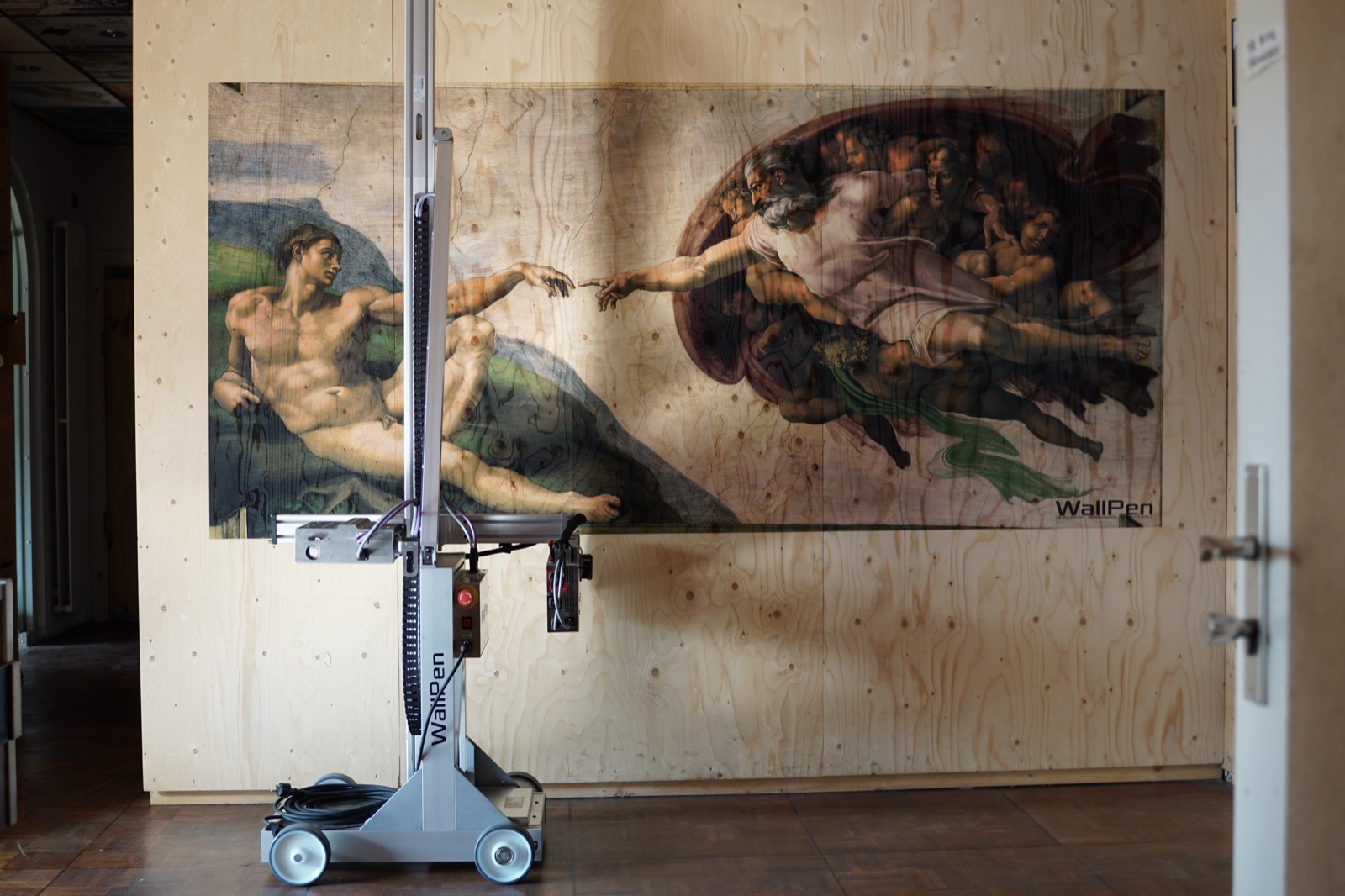
Direct to wall printing removes that constraint. The image is generated once, at the size of the wall, so a photograph can run corner to corner without being cut into panels, and a pattern repeats only if the design wants it to. It can run across a corner if it is set out for that, which is what happened in Business Bay: the scene continues around the edge rather than stopping at it. The machine prints on any material, so plaster, concrete, painted board, tile, wood and glass are wall surfaces rather than exceptions.
The ink: vegan, sustainable and non-flammable, and what that does not cover
The wallPen uses vegan, sustainable inks, and the inks are non-flammable. That is a property of the ink itself, and it is the only fire-related statement we make.
It is worth being blunt about what it does not mean, because this is where a specification gets misread. A wall is not an ink. It is a build-up: the structure behind it, the board, the plaster or render, the paint already on it, and only then the print. A project's fire strategy addresses that whole build-up. It belongs to the project and to the authority that signs the project off, not to a printer.
So we claim no class, no rating and no approval, for the ink or for the wall. If your project has a fire strategy, ask us for ink documentation and put it in front of whoever is compiling the case.
No lingering smell, and a finish that takes daily contact
Two published details from the Business Bay job matter more than they sound. The inks left no lingering smell, so the room was usable straight away rather than after airing out. And the print has a water resistant, scratch resistant finish.
The first is a programme fact. On many refurbishment methods the constraint is not the work but the wait afterwards, and a wait means a room out of use. The second decides whether the wall survives being a wall: office and retail walls are touched, leaned on and wiped down.
One point of precision: no lingering smell is a statement about smell. It is not a statement about air quality, and we do not extend it into one.
wallPen, vinyl, wallpaper or a hand-painted mural
A comparison that ends with one method always winning is not worth reading. These are different mechanisms, with different failure modes and different jobs.
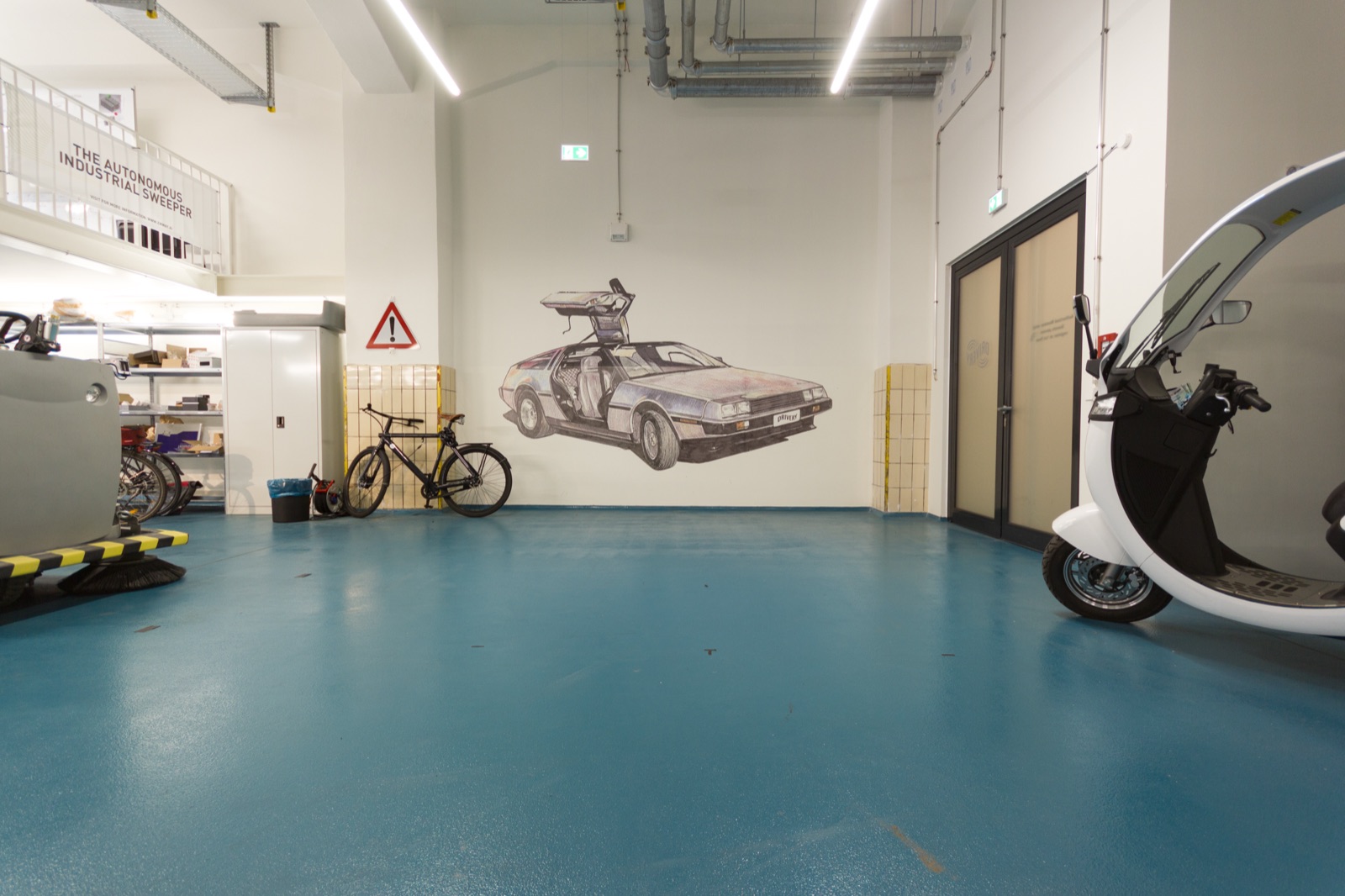
Vinyl and wallpaper are sheets. They are made away from site to a consistent standard, and they can be taken off again. Their weaknesses are structural: seams, edges, an adhesive bond that has to hold in Dubai humidity, and a repair that means replacing a piece rather than fixing a spot. A hand-painted mural is a person, and that is its strength. Nothing else gives you an artist's hand and brush texture. Its constraints are structural too. It is slower, the room is occupied by the work for as long as it takes, and it cannot be repeated exactly. If the same mural is wanted in nine branches, a hand cannot give you that. A file can.
- Vinyl or film: temporary campaigns meant to come off, tenancies where the wall may not be altered, glass and curved fittings, and anything that has to be removable without redecoration.
- Wallpaper: where a physical material is part of the design, such as texture, weave, embossing or a fabric a printed image cannot imitate.
- A hand-painted mural: where authorship is the point, and on geometry or in a location a machine cannot be set up against.
- Direct to wall printing: artwork at wall scale, in occupied buildings, with no seam, and where the same image has to appear exactly the same in more than one place.
What the wall needs to be, and what to check before you book
The method is relaxed about material and particular about condition. A print is only as sound as the surface underneath it, so the checks are the ones a good decorator would make before painting.
Photographs of the wall, a width and a height, and a note on what it is made of are usually enough for us to say yes, no, or not until something is done first.
- The surface is sound: no flaking or loose paint, no powdering plaster, nothing that can come away and take the print with it.
- It is clean and dry. Fresh plaster and paint must be fully cured, and the final coat should already be on.
- There is no active damp. Damp behind a wall is a wall problem, and printing over it changes nothing about the cause.
- The texture is understood. Coarse render reads through the image, so fine detail belongs on a smoother wall.
- The print area is agreed around what is fixed to the wall: sockets, switches, alarm devices, skirtings, shadow gaps and the ceiling line.
- There is clear floor space along the wall for the machine, a power supply, and access arranged, including building hours and any permits.
- The artwork exists at the right scale and resolution for the finished size.
When the design changes, you repaint and reprint
A printed wall is not permanent in the way a tiled wall is permanent, and that is an advantage rather than a caveat. When the campaign changes or the tenant changes, the wall is painted out with the same paint the rest of the room uses, and a new image is printed onto it. There is no removal and no adhesive residue. The surface goes back to being an ordinary painted wall.
That suits walls with a life cycle rather than walls meant to be finished forever, and it changes what is committed to at approval: a print session on a wall you already own.
Where direct to wall printing is used, and who runs the machine in the UAE
Sun Studio does wall printing in Dubai and across the Emirates from Al Quoz First, as the direct to surface printing division of PRO TECHnology Middle East, the authorised distributor for the wallPen across the region. The machine that prints your wall and the company that supports it sit in the same group.
Sector detail lives on its own pages, and each goes further than this one should. Museums, galleries and cultural spaces are covered separately. So are offices, retail interiors and experiential branding. Schools and healthcare have their own page. And if you are looking at the wallPen as a wall printing machine to own and run rather than as a service, the wallPen page for the UAE covers that.
The studio is in Al Quoz First, but for wall work the machine travels. You do not bring a wall to a printer.
Common questions
Sun Studio has printed direct to surface in Al Quoz First, Dubai since 2011, as the direct to surface division of PRO TECHnology Middle East, authorised distributor for the wallPen across the region. If you have a wall in mind, send photographs, a width and a height, and a note on what the wall is made of. We will tell you whether it can be printed as it stands, and what it needs first. Call +971 4 346 7422 or email info@sunstudio.ae.
ملخص بالعربية
الطباعة المباشرة على الجدران: ما هي آلة wallPen وما الذي تُغيّره
wallPen طابعة تنتقل إلى الجدار وتطبع عليه. لا لوح ولا لاصق ولا وصلة. وهذا ما يتغيّر لكل من يضع مواصفة جدار. تكاد كل طريقة لوضع صورة على جدار أن تصنع الصورة في مكان آخر أولًا.
اقرأ المقال كاملاً بالعربية ←