Custom Printing on Leather in Dubai: Photos, Artwork and Logos on Natural and Faux Leather
A photograph, a painting, a logo or a name, printed in full colour straight onto natural leather, PU or faux leather at our studio in Al Quoz. One piece or a run, every piece can be different, and the grain of the leather stays visible through the print.

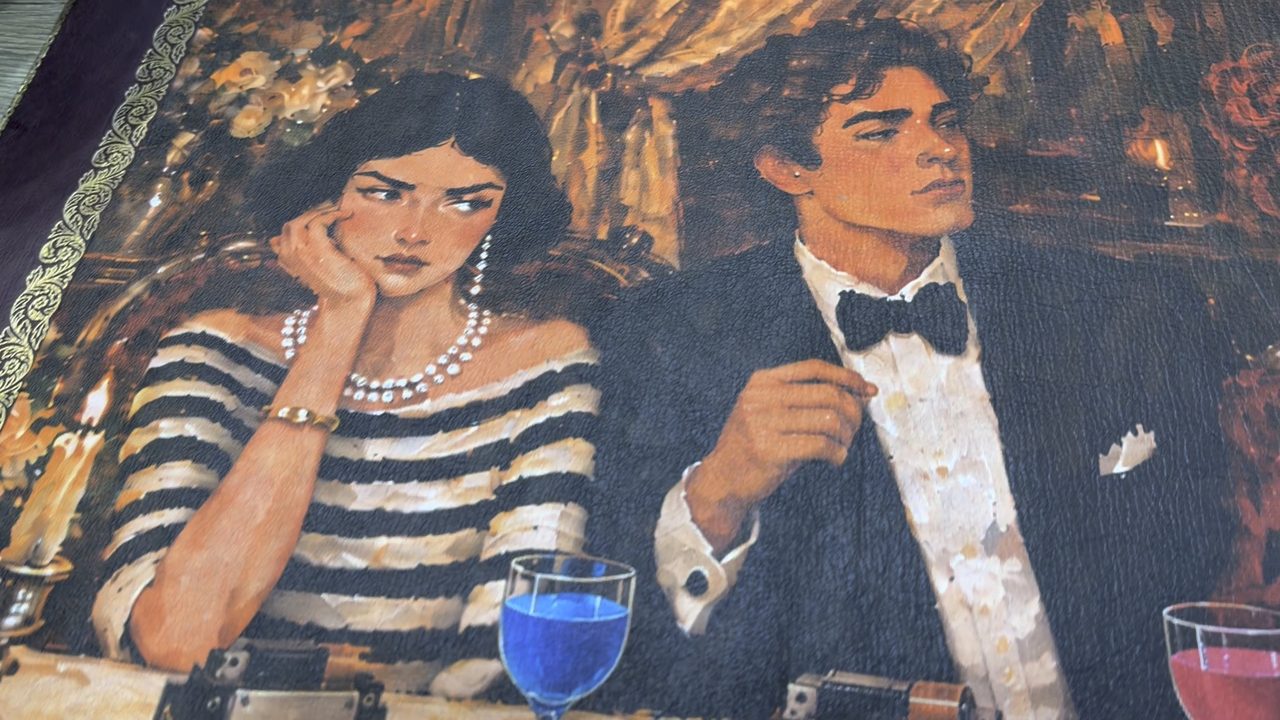
Yes, you can custom print almost anything onto leather in Dubai: a family photograph, a painting, a brand logo, a pattern, or a different name on every piece. Sun Studio prints it in full colour with UV-cured ink, directly onto natural leather, PU, faux and vegan leather, at our studio in Al Quoz. There is no screen, plate or die to make, so a single piece is a normal order, and the grain of the leather stays visible through the artwork.
The panel in the photographs is the proof. It is natural leather that came to us with its gold-coloured border already in place, and we printed a dinner-party painting inside it: seven guests at a long table, printheads for place cards and wine glasses of cyan, magenta and yellow, a nod to the inks it was printed with. Look closely and the grain of the hide runs through the brushwork.
Below: what can be printed, which leathers take it, how UV printing compares with DTF, sublimation, engraving and foil, how long a print lasts and what it costs. To order, go straight to our leather printing in Dubai page. For the technical difference between natural hide and PU, read can you UV print on leather?
Can you print a photo or a painting on leather?
Yes, in full colour and in photographic detail. A UV flatbed lays the image down as fine droplets of cyan, magenta, yellow and black ink and cures them solid with ultraviolet light the moment they land, so a photograph, a painting or a gradient reproduces on leather much as it would on paper.
Two things make it work on leather. The first is white ink. Process colours are transparent, so on tan, brown, burgundy or black leather they would sink into the hide. A white layer printed underneath, in register with the image, keeps skin tones, whites and brand colours true. Where white is left out on purpose, the colour of the leather becomes part of the picture.
The second is the surface. UV ink cures where it lands instead of soaking in, so the print follows the grain rather than hiding it under a film. That is why the painting in our photographs still reads as leather: in the video below, the fine grain of the hide shows through the brushstrokes.
Send the largest original you have. A recent phone photo is normally plenty for a wallet or a notebook cover; a panel the size of this one needs a high-resolution file, and an AI image or an old scan may need preparing first. Our guide to preparing artwork for UV printing covers which file to send, and if all you have is an idea, we can help turn it into print-ready artwork.
How is an image printed onto leather?
Flat on a UV flatbed, with the ink cured as it lands. This is the order of work in our studio:
- Identify the leather and its finish. The ink bonds to the finish on top of the hide, not to the hide itself, so we check what the finish is: pigmented, aniline, waxed, or a synthetic PU coat.
- Clean and pre-treat. The surface is cleaned and degreased, and when the finish needs it, a pre-treatment chosen for that leather is applied on our Modico ModiTreat. Many leathers take UV ink well without a primer; a waxed or silicone-treated finish does not.
- Lay it flat and place the artwork. Leather goes on the bed flat, as pieces before assembly wherever possible, and the artwork is positioned to the piece. That matters when a print has to sit inside a border, a stitch line or a logo area, like the gold-coloured border that was already on this panel.
- Print white, then colour. The white layer goes down where the design needs it, then the colour, and, where the job calls for it, a raised layer you can feel or a clear finish.
- Cure and check. The UV lamps on the carriage cure the ink pass by pass, so the piece comes off the bed dry and can be handled, flexed and checked straight away.
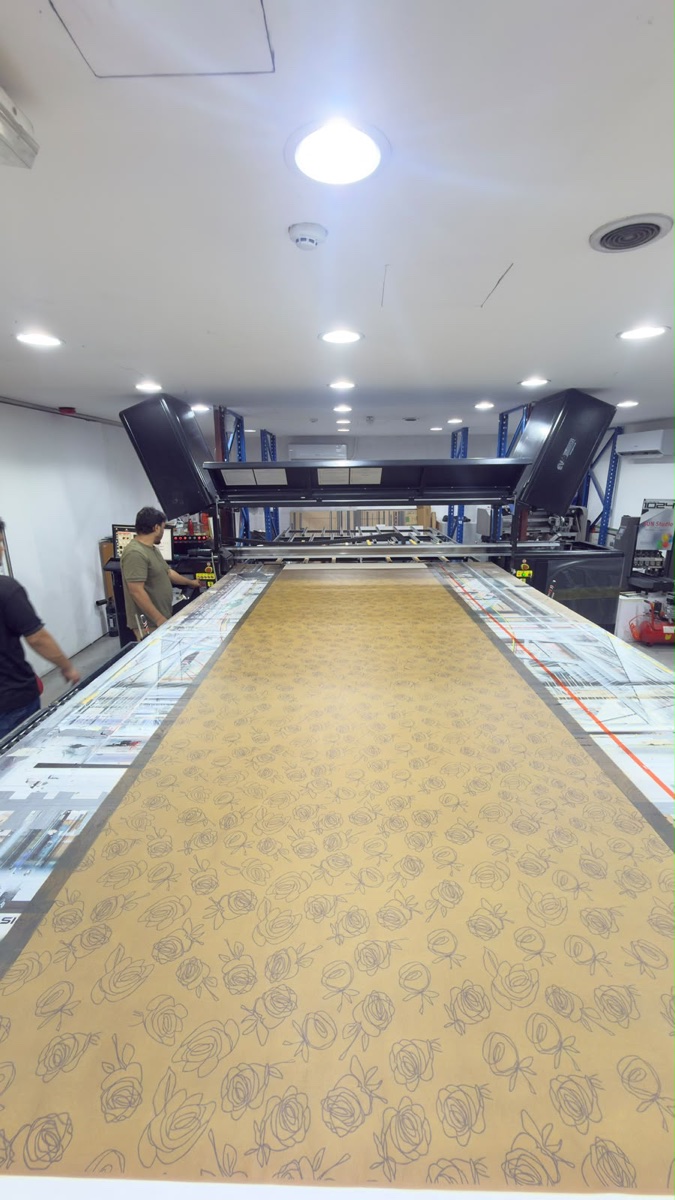
The video shows the panel under the carriage of our IQDEMY EVO 2500, a belt flatbed 2.5 metres wide with no machine limit on length. Leather panels and covers also run on our Direct Color Systems UV84 flatbed. Sun Studio belongs to the same Dubai group as PRO TECHnology, which distributes Direct Color Systems and IQDEMY equipment in the Middle East, so read our view of the machines with that in mind.

Which leather can you print: natural, PU, faux or vegan?
All of them, but they do not print the same way. The ink meets the surface, so the finish tells you more than the name on the label does.
| Leather | What it is | How it prints | Check first |
|---|---|---|---|
| Natural leather (genuine, real) | Animal hide with a finish or topcoat | Full colour with the grain showing through; colour and absorbency vary across a hide | A test print on the actual hide, above all for pieces that flex |
| PU leather, leatherette and faux leather | A polyurethane coat on a fabric backing | The most consistent surface, so colour repeats from piece to piece | Whether the coat is soft-touch or silicone-treated |
| Vegan leather | A label, not one material: usually PU, sometimes PVC or a plant-based sheet | Depends on what it actually is | Ask your supplier what it is made of, then test |
| Bonded leather | Leather fibres bound together under a coating, common on notebooks | Prints like the coating on top | Edges and folds |
| Suede and nubuck | Leather with a brushed, open surface | Ink sits on the nap, so fine detail softens | Whether a soft, matte look suits the design |
Natural leather is sold under several names: genuine, real, full-grain, top-grain, and sometimes organic or vegetable-tanned. For printing, the grade and the tanning matter less than the finish on top. A smooth, finished hide holds detail far better than a waxed or heavily oiled one.
What flexing does to a print on hide and on PU, and why fashion, car interiors and furniture are specified differently, is covered in can you UV print on leather?
UV printing, DTF, sublimation, screen printing, laser engraving or foil: which suits leather?
For full colour on real leather, direct UV printing is the method that does it without a transfer film, a die or a polyester coating. Each of the others is right for a narrower job:
| Method | What it does to the leather | Colour and photos | On natural leather | Best for | At Sun Studio |
|---|---|---|---|---|---|
| Direct UV printing | Ink jetted onto the surface and cured by UV light | Full colour, white, raised effects | Yes, after a test print | Photos, logos and names, one piece or a run | What we do |
| UV DTF transfer | A printed film with adhesive, pressed onto the piece | Full colour | It sticks, but the film edge lifts where leather bends | Quick decals on rigid items | Not offered |
| DTF heat transfer | A printed film with adhesive powder, heat pressed on | Full colour | Leather has to take the heat, and a film sits on top | Garments and fabric | Not offered |
| Sublimation | Dye turned to gas and absorbed into polyester | Full colour, no white | No: only polyester-coated faux leather blanks | Keyrings, coasters and patches made for it | Not offered |
| Screen printing | Ink pushed through a mesh stencil, one screen per colour | A few flat colours; not suited to photographs | Yes, with the right ink | Long runs of a one- or two-colour logo | Not offered |
| Laser engraving | A beam burns into the surface | One tone, darker than the leather | Yes | Permanent names and logos in one colour | Not offered |
| Embossing, debossing and hot foil | A heated die presses the leather, with or without metallic foil | No ink; foil gives gold or silver | Yes | Classic logos on notebooks, wallets and boxes | Not offered |
If your job is a one-colour logo on five hundred wallets, an engraver or a foil stamper may be the better buy, and we will tell you so. If it has a photograph, a gradient, more than two colours or a different name on every piece, that is what direct UV printing is for.
The same comparison across every material is in UV printing vs screen printing, pad and sublimation, and why transfers lift is explained in why UV DTF peels.
What can be custom printed on leather?
Anything with a face that can lie flat on the bed. The pieces we are asked for most:
- Notebooks, diaries, journals and portfolios: the biggest category, mostly corporate, often with a different name on every cover. See leather printing in Dubai.
- Wallets and card holders: a photo, initials or a pattern on the flat face.
- Keychains, tags, labels and patches: cut pieces printed flat before they are stitched or riveted on.
- Bags and bag panels: panels before assembly print best; a finished bag works where a flat area can lie on the bed.
- Jackets: panels before they are sewn are the safe route. Across a seam or a fold is where a print is most likely to crack.
- Coasters, placemats and desk pads: flat and ideal for a set in which every piece carries its own design.
- Wall art and framed leather panels: a painting or a photograph on leather, like the panel in this article, for homes, offices and hospitality spaces.
- Upholstery and furniture panels: printed before they are fitted; see furniture printing.
- Menu covers, folders and gift sets: hotels, restaurants and gifting companies; see corporate gift printing.
Sun Studio prints leather goods but does not make them. You or your supplier provide the items or the cut pieces, plus a spare piece of the same leather for the test print.
Every piece can carry a different name, photo or number from the same file, and a different name on each piece adds no setup cost. Personalised gifts and one-off portraits are normal orders here, and there is no minimum order.
Will printed leather crack, peel, fade or rub off?
That depends on how the piece is used more than on the ink, which is why we test leather before a run. A leather print can fail in four ways, and each has its own prevention:
- Cracking comes from flex. A cured print is a thin, rigid layer. On a panel, a cover or a wall piece it is never asked to bend; across the fold of a wallet or the elbow of a jacket it bends all day. Keep artwork off working folds where you can, and we flex the test print before quoting a run.
- Peeling comes from the bond. The ink holds to the finish of the leather, so a waxed, oiled or silicone-treated finish, or a dirty surface, is where it lets go. Cleaning, the right pre-treatment and a test print deal with it. More in why UV print peels.
- Rubbing is wear from hands, pockets and desks. A clear varnish over the colour takes that wear first, and artwork kept away from edges and corners lasts longer.
- Fading is about light. Indoors, a cured UV print on a properly prepared surface is a long-life finish. Outdoors in Gulf sun, colour fades over time, and leather itself changes colour and dries out in strong sun, printed or not. How long UV printing lasts explains what decides it.
To clean a printed leather piece, wipe it with a soft, slightly damp cloth. Keep solvents, alcohol-based cleaners and scouring pads off the print, and try any leather conditioner on a hidden spot first.
What does custom leather printing cost in Dubai?
It is quoted per job, because size, quantity and the number of ink layers decide it. What moves the price:
- Print area and the size of the piece.
- Quantity: the price per piece falls as the quantity rises.
- Layers: a white underlayer, a raised logo or a clear finish each add a pass.
- Personalisation: a different name or photo on each piece adds no setup cost, though every piece is still loaded and checked.
- Preparation: pre-treatment and the test print on your leather.
A test print is the usual first step. A sample is AED 105 or AED 150 depending on what it is, the fee comes off the invoice if you go ahead, and it is usually ready in one to three working days once the artwork is approved.
There is no minimum order, so a single photo panel or one personalised wallet is quoted like any other job. How UV quotes are built is explained in UV printing cost in Dubai.
How do I order a custom leather print in Dubai?
Send us the piece, or a spare of the same leather, with the artwork. Include:
- The item or the cut pieces, or a photo and dimensions to start with.
- A spare piece of the same leather for the test print.
- Natural, PU or faux, or tell us you are not sure.
- The artwork: a photo, a logo file or an idea.
- Quantity, and whether each piece is personalised.
- Where it will be used: on a wall, on a desk, in a pocket or in a car.
- Your deadline.
We are in Al Quoz First, Dubai, and print for clients across the UAE. You can also start from our leather printing service page, or browse the Leather filter in our gallery.
Looking for a leather printing machine rather than a printing service? The flatbeds we print on are sold in the region by PRO TECHnology: see the Direct Color Systems UV flatbeds and the IQDEMY belt printers.
Common questions
Is it possible to print on leather?
What is printing on leather called?
Can UV DTF be used on leather?
Can you sublimate on leather?
How permanent is UV printing on leather?
Can you print on a leather jacket?
Can you print a photo on a leather wallet or keychain?
Is faux or vegan leather easier to print than real leather?
Have a photo or a logo for leather?
Send it with the piece, or a spare of the same leather. We will test it, show you the result on your own leather and quote the run.
Sun Studio LLC
Al Quoz First, Dubai, United Arab Emirates
Call: +971 4 346 7422
Email: info@sunstudio.ae