Can Candle Jars Be Printed Directly? A Dubai Guide to Glass, Wax and Filled Jars
Yes. Sun Studio prints directly onto customer-supplied glass candle jars in Dubai, empty or already filled, and onto suitable wax pillar candles. Empty jars are preferred; each job is proved on the actual vessel.


Yes. Sun Studio prints directly onto customer-supplied glass candle jars in Dubai, whether they are empty or already filled, and also prints suitable wax pillar candles. Empty jars are preferred because they are easier to clean, jig and handle; filled candles can be printed when the vessel, packing and surface are suitable. Sun Studio prints only: it does not supply jars, pour wax or sell finished candles. There is no minimum order.
A candle is two objects that behave nothing alike: the vessel and the wax. We print both directly, with no label in between. Plan a gifting run with your candle maker first, then use our candle jar printing service to send the vessel, artwork and quantity for a sample and quote.
What we print, and what we do not
Round glass goes on a cylindrical press; a square or flat-faced jar is flat work, like a lid, and is quoted separately. Wax is soft and heat sensitive, and is quoted on its own. Decide first which surface carries the artwork: a kept favour usually gets the names on the glass; a one-evening table piece gets the artwork on a pillar.
- Clear glass jars: colour alone tints the wax; a white base makes it read as colour.
- Frosted glass: a dark single-colour design reads directly, with no white base.
- Amber, green and black glass: a white base goes under the colour.
- Lacquered or coated glass: the ink bonds to the coating, so it is sampled first.
- Glazed ceramic and coated tins: each subject to a test on the piece itself.
- Wax pillar candles: printed on the wax, all round.
- Metal and wooden lids: a flat printable face, checked on a sample, as separate flat work and quote.
A frosted diffuser bottle is a related piece. Heavily ribbed, faceted or hammered jars are unsuitable, and reeds, wicks, labels and stickers are not printed.
Printing on wax candles
Wax is soft, so the cured film rests on a surface a fingernail can mark. It is also low in surface energy. Every wax job is therefore proved on a sample of the exact candle. A heat-cured process would soften the candle first; LED-UV curing puts very little heat into it. Printed pillars are display and gift pieces, not built to be scrubbed. A pillar burned to the end loses the artwork as the outer wall melts, and we do not describe UV inks as approved for flame contact.
Fête Events brought one theme, from their own design team, to printed velvet chairs and wax pillar candles. Wax returns light differently from velvet, so the work was agreeing what had to match (key colour, weight of type) and letting the rest differ.

Wax carries detailed religious artwork too: we have printed icons on wax candles as church gifts, with gold-coloured haloes and frames as part of the print.
Design possibilities beyond a logo
With no screens or plates, the artwork can be anything a file holds: a full-colour illustration wrapped round the jar, a minimalist mark in fine type, an edge-to-edge pattern, or one colourway per fragrance. Arabic calligraphy, names and dates hold at small sizes; Arabic can face one way and English the other, supplied as outlines.
White ink is a design decision. Process inks are transparent, so on clear, amber, green or black glass colour alone reads as a tint over the wax. White laid down first gives the colour a ground and keeps it constant as the wax level drops. It can go only under chosen elements, so the glass stays part of the design, and it is an extra layer in the quote.
A full wrap depends on geometry: a straight-sided jar lets the band run its full height; a taper or shoulder sets it over the straightest part, with margins at rim, base and shoulder. Our guide to how 360° bottle printing works covers the wrap file.


How the LSINC presses handle candle jar printing
Candle vessels are printed on two American-built cylindrical UV presses from LSINC of Huntsville, Alabama (see our LSINC PeriQ360 guide).
Sun Studio belongs to the same Dubai group as PRO TECHnology, which distributes LSINC equipment in the Middle East, so read our view of the machine with that in mind.
LSINC calls the print type helical: the heads track along the jar while it turns, so the image is laid as one continuous spiral. Every jar closes its wrap at the same point, and a pattern built to the true circumference closes with no physical seam. Resolution and colour hold across diameters, so fine type on a small jar and the same artwork on a wide vessel read as one brand in a gift set.
The PeriQ360 carries four jars at a time; LSINC publishes its limits as 38 to 114 mm in diameter, up to 406 mm long and a taper of plus 10 to minus 2 degrees. The single-spindle, hand-loaded PeriOne takes samples and wider vessels; LSINC rates it to 152 mm across and 457 mm long. These are the manufacturer's limits, not a promise for every vessel inside them.
Raised and embossed-effect finishes
A pass of UV ink or varnish is solid the moment it leaves the lamp, so the next goes straight over it, and passes stack until the artwork stands off the glass. LSINC's own names for it are tactile effects and faux embossing, and faux is the right word: moulded embossing shapes the glass and engraving cuts into it, while this adds material to an ordinary jar from the artwork file.
The usual starting point is a raised logo, a mark a hand finds before the eye does. The same build gives a monogram on a wedding favour, botanical detail round a fragrance collection, a geometric texture over the body or a single raised word in the name, alongside smooth full-colour artwork. Gloss varnish on the raised element against a matte field adds shine to the touch; on a luxury jar a little texture works harder than a large logo.
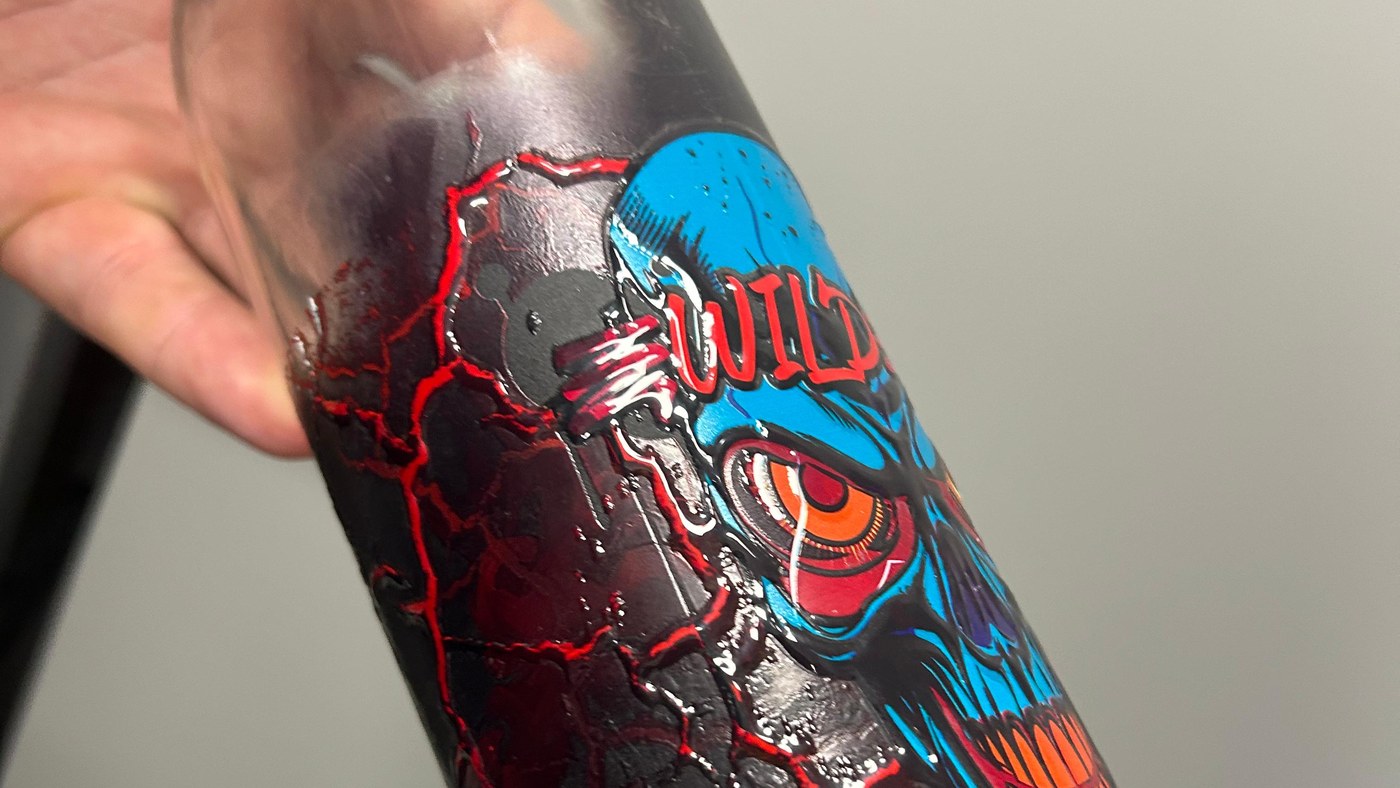
In the file, a raised element is its own layer, in ink or varnish, printed more times than the rest. Height is press time, so the area you texture matters more than the size of the jar. A tall build has softer edges, so hairline detail should stay flat. Relief on a round vessel depends on the piece and the artwork, so we sample it on your own jar. We quote no relief height for the cylindrical presses; our raised and tactile UV printing guide gives figures for flat panels only.
Pre-treatment: where adhesion is decided
Three things have to happen for a print to last: the ink cures into a solid film, that film bonds to the glass, and the bonded print resists the wear the candle meets.
Every jar is cleaned and degreased. Where the material needs it, it goes through our Modico ModiTreat, a German unit that removes contamination, raises surface energy so the ink wets, and leaves an adhesion promoter the ink cross-links into. Not every jar gets every treatment: the need is decided on the actual glass, a lacquered or glazed vessel makes its coating the real print surface, and wax is proved on the candle itself. More in why UV print peels and what pre-treatment does about it.
Ask any printer:
- What is my substrate, including any coating or lacquer?
- Which cleaning and pre-treatment will you use, and why?
- Will you cross-hatch my sample, and which check matches how my candle is used: rubbing, wiping or burning?
- Will the sample be printed on one of my own jars rather than a stock blank?
Heat: printing, hot wax and burning
Whether a print copes with a burning candle is settled on your own jar, not by a blanket claim.
A. Heat during printing
LED-UV curing puts very little heat into the jar or its contents, which is why poured candles go through the press. Very little is not none: surviving the press shows the print can be made, not how it behaves in use.
B. Heat from hot wax filling
If jars are printed empty and filled afterwards, the pour warms the printed glass from the inside, and any heat-then-cool cycle can work the bond. We do not pour, so we suggest putting the sample jar through your own pour and looking at it cold for lifting, cracking or a change of colour.
C. Repeated warming while the candle burns
A burning candle warms the vessel, so we print one of your jars and check it. The result depends on the vessel, its coating and preparation, the ink build, the cure and how the candle is used. If the candles will be burned, burn one before approving the batch and look for softening, peeling, discolouration, cracking or loss of adhesion. We have no burn-test figure or temperature rating to quote, so a "will not melt" claim is earned on your candle, not asserted.
Scratch resistance and everyday handling
We say scratch-resistant only about a tested combination, never that nothing can scratch the print. A clear UV-cured varnish over the colour is a sacrificial layer: it takes the rubbing of cloths, tissue and hands, but a key or grit in a cloth can still score it. A stack fails at its weakest boundary, so preparation and a full cure count as much as the varnish.
The cross-hatch tape test cuts a grid, presses tape over it and counts what comes away. It settles only whether the ink is bonded, so a tape test alone is no evidence of heat or scratch resistance. On jars we cross-hatch a printed sample and, where the end use calls for it, run the alcohol and solvent rub we use on fragrance and cosmetics containers.
Much of the wear happens in the carton and on the shelf, so we pack printed glass to protect the print. Rack or box jars so they do not touch, and keep artwork below the rim where the jar's shape protects it.
Printing empty jars or filled candles
Empty is the route we recommend: the jar is lighter, easier to jig, has no wax or wick residue to clean off, and no finished stock is at risk. Filled candles can be printed, and often are. The two candle jars below were printed after the candles were poured, contents in place. The artwork runs the height of each jar, because the ink only meets the outside of the glass. The frosted diffuser bottle beside them came off the same press.


Candle jar printing on a filled candle changes the handling, not the print band. The candles must arrive dry and at room temperature, because ink will not bond to condensation. On clear glass the fill line shows through the design, so plan around it. Suitability depends on the product: tell us how the candles are packed and we print one first. Watch the PeriQ360 print filled bottles and candle jars.
No minimum order, and who that serves
A candle maker's minimum comes from the pour, not from printing (see our guide to minimum order quantities). With no screens, plates or dies, Sun Studio has no minimum order quantity.
- A new candle business: one design on one suitable jar.
- One-off samples: one vessel checked against your wax and packaging.
- Small fragrance collections: no plate per variant, so four fragrances cost no more to originate than one.
- Personalised wedding favours: a different name on every jar.
- Corporate gifts: a motif or calligraphy that keeps the jar in use.
- Hotels and spas: branded jars for tables and rooms.
- Ramadan, Eid and festive editions: seasonal artwork on a fixed date; see our Ramadan and Eid gifting guide.
- Larger repeat orders: the approved settings, run again.
No minimum does not mean no setup. The first jar carries the fixturing and setup time, and the price per piece falls as the quantity rises; a name list adds checking, not tooling.
Direct print, labels, screen printing or UV DTF
Labels are cheap, quick and easy to change, which suits batch codes and dates. Their weakness is the edge: a jar gets warm as it burns, is handled with oily fingers, and is washed out to be reused.
A direct print has no corner, the same reasoning behind printing direct rather than applying a transfer.
| Method | Appearance | Tactile options | Personalisation | Setup | Verifying durability |
|---|---|---|---|---|---|
| Direct UV printing | Ink on the glass | Raised effects; selective varnish | Every piece can differ | Fixturing and a sample | Cross-hatch here; burn and fill your sample |
| Adhesive labels | Paper or film with an edge | Textured or foiled stocks | Easy on digital presses | Low; reprint to change | Test the edge: warmth, oil |
| Screen printing | Crisp spot colours | Thick ink; no built relief | New screen per text change | A screen per colour; a minimum | Still test your jar |
| UV DTF transfers | Printed film, hand applied | None beyond the film | Good; digital | Low; placement varies | Test the edge and adhesive |
One fixed design at very high repeat volume can be cheaper screened or padded; the comparison between the processes shows where each wins. Direct print earns its place on the jar that is kept: fine script, a raised monogram, a name on every favour.
What drives the price, and what to send
The main drivers are quantity, material, finish and shape, print area, ink build (including a white base on clear or dark glass), raised layers, artwork variation, and preparation and sampling. See what drives a UV printing quote, and send:
- Photos, front and side, lid included if it is printed.
- Material and finish: clear, frosted, amber, black, lacquered, cast, ceramic, or wax.
- Height, outside diameter, and the height of the straight printable band.
- Empty or filled, and how filled candles are packed.
- Quantity, and whether pieces share one artwork or carry different names.
- Artwork as vector (AI, EPS or PDF) or 300 dpi at final size, with white, varnish and raised elements marked; see our artwork guide.
- Where the candles are going (favour, retail, corporate gift, or to be burned) and your deadline.
Send one sample jar or candle: from it and the photos we confirm the printable band and decide where white ink goes before anything is quoted. More candle work is in our gallery.
Common questions
Can you print directly onto glass candle jars, or only onto a label?
Can you print on wax candles?
Can I order one printed candle or jar?
How is a raised or embossed-effect logo built on a candle jar?
How do I know the print will cope with the heat of a burning candle?
What does scratch-resistant mean for a printed candle jar?
What changes when the jars arrive already filled with wax?
Can I supply my own jars?
Can each piece have a different name?
Send artwork and, if you can, one sample jar or candle to info@sunstudio.ae, or call +971 4 346 7422. We are in Al Quoz First and print for clients in Dubai and across the UAE, with no minimum order quantity. Tell us whether the jars are empty or filled and what happens to the candle afterwards, and we will print a sample on your own jar before the batch runs. You can also reach us through the contact page.